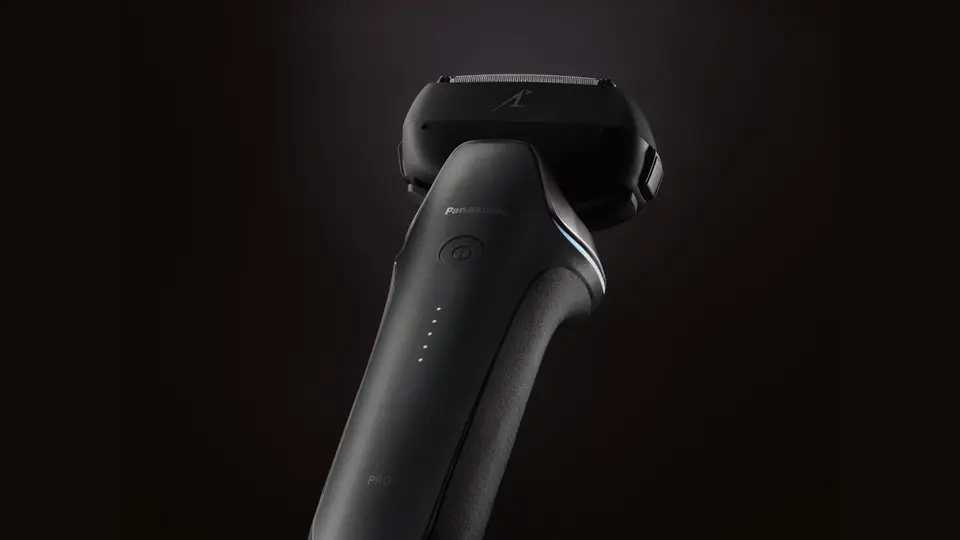
On November 24, 2026, Bambu Lab launched the P3C, a desktop 3D printer with a seven-slot automatic tool changer that it says brings multi-material printing to more creators, starting at $1,149 (Bambu Lab via PR Newswire).
Key takeaways
- Multi-material prototypes are getting cheaper to make in-house. A printer that swaps between rigid and soft materials in one job lowers the cost of grip, seal and soft-touch studies.
- A printed soft-touch part is not a molded overmold. Bond strength, feel and durability of layered TPU on a rigid print can differ from a two-shot molded part.
- More materials per print means more ways to fail. Interface adhesion, moisture in filament and tool alignment become things to check, not assume.
- The machine changes the prototype mix, not the process. Teams still need to match each design question to the method that answers it honestly.
What Bambu Lab announced: P3C at a glance
According to Bambu Lab's release, issued from Austin, Texas on November 24, 2026, and the company's launch blog post, the reported details are:
- Tool changer: a Swaptek system with seven tool slots, five 0.4 mm PrintTools installed and two open. Each tool carries its own filament path, heater, power and data connection, and the printer pre-heats the next nozzle so a material change takes about 6 seconds with minimal purge.
- Materials: an integrated AMS 3P unit stores seven spools in sealed compartments, with an optional two-slot 75 °C dryer. A FlexFeed extruder accepts both 1.75 mm and 2.85 mm filament; Bambu says the larger size lets it print TPU as soft as 75A at higher flow.
- Mixed nozzles: 0.2, 0.4, 0.6 and 0.8 mm hardened-steel nozzles can be used in one job, for fine detail in some regions and fast deposition in others.
- Specs: 256 × 256 × 260 mm build volume, 300 °C nozzle, 110 °C bed, HEPA H11 filtration and support for engineering grades such as PA, PC and fiber-reinforced blends.
- Positioning: Bambu says the P3C carries over the core of its $2,499 H3C at about half the price. Its examples include a watch printed in one job with a fine dial, rigid body and soft TPU strap, and a shoe combining TPU of different hardnesses. For small studios, it says client prototypes no longer have to be "printed in pieces, often on different machines, then glued and painted by hand."
What the sources do not state: bond strength between dissimilar materials, dimensional accuracy, or how prints compare with molded parts. Bambu notes that its tool-changing design "requires more mechanical components." We have not tested the printer.
Why multi-material printing matters to product teams
Most consumer products combine rigid and soft materials: a hard housing with a rubbery grip, a button under a flexible membrane, a case with a sealing gasket. In production these are usually made by overmolding or two-shot molding, where a second, softer plastic is molded onto or around a rigid part inside the tooling (the custom molds used to make parts at volume).
Prototyping that combination usually meant gluing separately printed pieces or casting silicone and urethane. A tool-changing FFF printer (fused filament fabrication, which builds parts from melted plastic filament layer by layer) can lay down both in one build. That is a real shift in what a quick, cheap prototype can show. Fast build-and-test loops matter just as much for electromechanical systems, as our look at coprod's modular robot hardware explains.
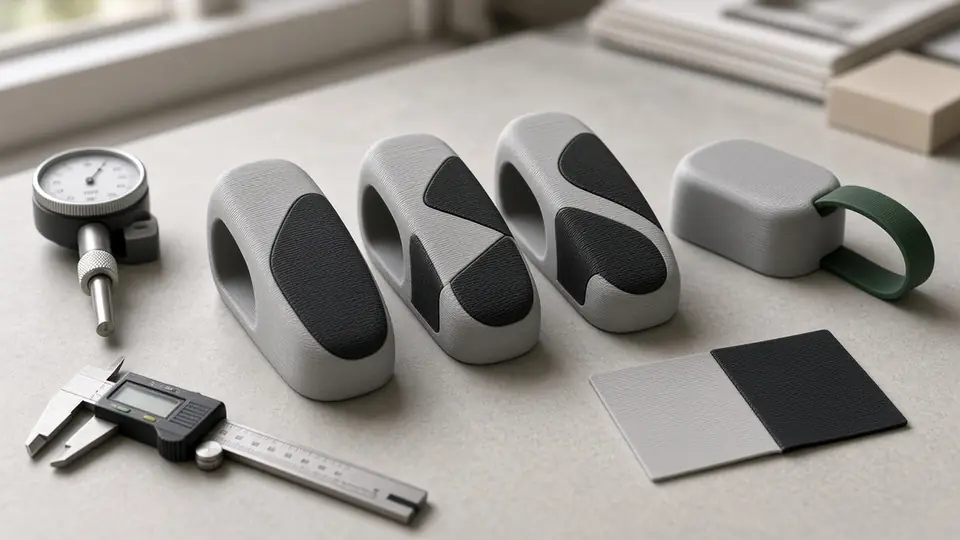
Concept render (illustration) of generic soft-and-rigid printed prototypes, not Bambu Lab parts or prints.
What this means for product teams
The following is Jackson Hedden analysis, not reporting; it is based on general product development practice, not on testing the P3C. Here is how we would expect a prototype development company or in-house team to use a machine like this, and where it would stop.
Use it for feel and layout questions. Grip shape, where soft zones sit, how a button membrane reads under a thumb, how a strap meets a case: these are early ergonomic questions where speed beats precision. Printing soft and rigid regions together, in colors close to the intended CMF (color, material and finish), makes user reviews more realistic.
Do not read production feel from printed TPU. Printed TPU at 75A and a molded TPE or silicone at the same durometer (a hardness scale for soft materials) can feel different, because infill, layer lines and wall thickness change how the part compresses. Treat printed softness as directional.
Test the material interface. In two-shot molding, materials are chosen to bond chemically or are locked together mechanically. In a print, the bond depends on material pairing and print settings. Peel and twist the joint before trusting it in a drop or wear test, and design mechanical interlocks into the prototype if the production part will have them.
Manage moisture and alignment. TPU, nylon and PETG absorb water, which degrades prints, and multiple tools must stay aligned. Both become part of the process.
Keep the production path in view. Undercuts, soft-on-hard boundaries and thin flexible walls that print easily may be expensive or impossible to mold. Design the prototype with draft, realistic wall thickness and shut-off lines where the soft material stops, so the lessons carry over to the tool.
When to print in-house and when to hire a prototype development company
Cheaper in-house iteration helps any team. Bring in outside help when the question changes from "what should this feel like" to "will the production part do this." That includes material-specific testing, appearance models with production-level finish, precise fits, and the decision of when to move from printed parts to printed mold inserts or soft tooling, the route we looked at in our Formnext 2026 coverage of 3D-printed mold inserts. A good partner should explain which method answers which question, and at what cost.
Matching soft-and-rigid prototypes to the right process
A practical sequence for a product that combines rigid and soft materials:
- Form and ergonomics: multi-material FFF prints to test grip zones, button placement and strap or seal layout quickly.
- Feel and durometer studies: cast silicone or urethane samples at known hardness, compared against printed TPU, to set the soft-material specification.
- Fit and precision: SLA (stereolithography, a precise resin 3D printing process) or CNC-machined parts where tolerances, snap fits or sealing surfaces matter.
- Material-true parts: printed mold inserts or aluminum soft tooling to shoot the real rigid and soft resins and test bonding, drop and wear.
- Production validation: EVT and DVT, engineering validation test and design validation test, the build stages that confirm the design works and then meets its requirements using parts from production tooling.
As we noted in our look at Nike's Tuned Air process, prototypes are most useful when they come close to the production process. Design for manufacturing (DFM), shaping parts so they can be molded and assembled reliably and affordably, should guide soft-on-hard geometry from the first print, because overmold tools are expensive to change once cut.
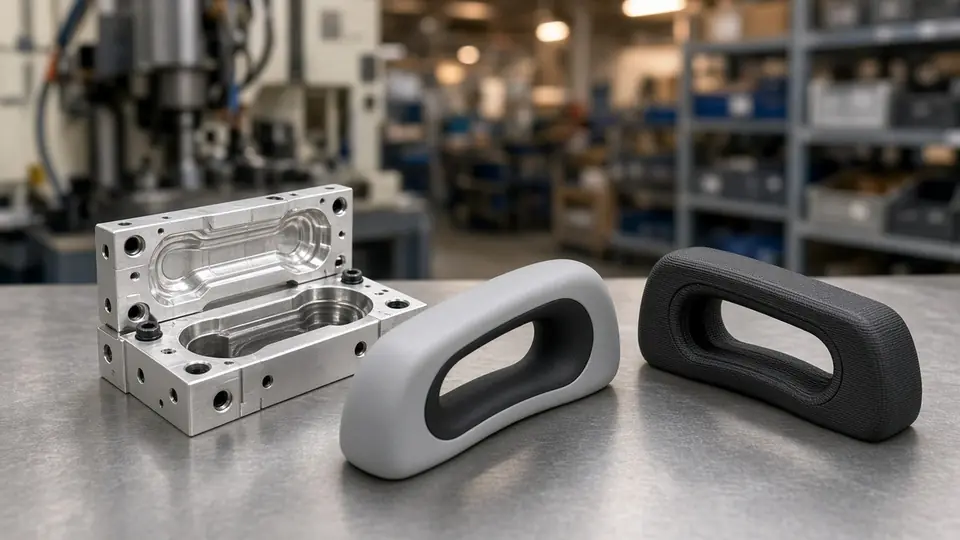
Concept render (illustration) comparing a printed prototype with a molded overmold part and generic tooling, not Bambu Lab parts.
Frequently asked questions
What is the Bambu Lab P3C? The P3C is a desktop 3D printer Bambu Lab launched on November 24, 2026, starting at $1,149. It uses a seven-slot automatic tool changer so one print can combine several colors and materials, including soft TPU and rigid plastics.
Can a multi-material 3D print replace an overmolded prototype? For early ergonomics and layout, often yes. For bond strength, soft-material feel and durability, a print is only an approximation; parts molded in the real materials are needed before committing to production tooling.
When should a startup hire a prototype development company instead of printing in-house? In-house printing works well for fast form and feel iterations. Bring in a partner when you need material-true parts, precise fits, production-quality appearance models or a plan for moving from prototypes to tooling.
What are EVT and DVT? EVT (engineering validation test) is the build stage where engineers confirm the design works as intended. DVT (design validation test) uses production-intent parts to confirm the product meets its requirements, including safety and reliability testing, before mass production.
Planning a product with soft and rigid parts?
If you are developing a product where grips, seals or soft-touch surfaces have to work with a rigid housing, see how we approach prototyping or contact us to talk through your project.
Jackson Hedden is a product design, development and manufacturing firm helping founders and product teams take consumer and industrial products from concept to production.
Sources
- Bambu Lab, "Tool Changer. Now Standard. Bambu Lab Launches the P3C - Make True Multi-Material 3D Printing Accessible to All Creators," PR Newswire, November 24, 2026.
- Bambu Lab, "Bambu Lab P3C brings home its H3C technology at half the price," Bambu Lab blog, November 24, 2026.
- Bambu Lab, "Bambu Lab P3C" product page, bambulab.com, accessed November 24, 2026.